We hope that through these 9 or so posts, you’ve learned more about anxiety.
We hope that you’ve learned that anxiety isn’t necessarily something we only face when we’re stressed, but can be an actual problem for almost 600 million people around the world.
We hope that you’ve learned that anxiety disorders actually refers to a collection of disorders whose roots all stem from anxiety.
And we hope that you’ve learned about the stigmas and misconceptions that some people with anxiety may face in Singapore and abroad, as well as the right answers to them so you’ll be able to paint the right picture of anxiety.
Strap yourselves in once more for our final 10 posts and follow us as we explore our last mental illness, depression.
VI. “With exercise, and a healthy diet, anxiety will go away.”
Undoubtedly having a good diet and lots of exercise is sound medical advice, and may help relieve some people’s mental tension. However, it does not actually help people with anxiety disorders. Exercise and maintaining a healthy diet are stress-relievers, and, according to the Anxiety and Depression Association of America, relieving stress does NOT cure anxiety. Instead, facing anxiety and taking the right medication are better ideas to help manage anxiety. The Association also suggests people with anxiety disorders learn more about their disorder and their symptoms plus learn tolerance for certain (not all) situations.
VII. “Medication may not help, and it may make people addicted.”
Medications like Benzodiazepines may help in the short-term, but they ultimately lead to increased tolerance and dependency on these medicines.
In spite of this, this misconception/stigma is absolutely WRONG. Medication is one of the most important things for those with anxiety disorders. Besides, not all medication is addictive. Medications, for instant, like SSRI and SRNI antidepressants are non-addictive.
VIII. “Taking medication will cure all symptoms.”
Medication is not useless, but neither is it completely useful. Medication is not a cure-all remedy for symptoms, let alone the disorder itself. It merely helps to, as mentioned before, manage symptoms . Despite this, taking medication can still, honestly, make a world of difference.
IX. “I can’t do anything about my anxiety disorder. “
Lots of anxiety patients may think this. Their surrounding family members may think this too. However, having anxiety does NOT automatically make you doomed for life. With an accurate diagnosis by a medical professional, proper treatment and support, patients with anxiety disorders CAN get better and live fulfilling, rich lives.
X. “Having anxiety is all my fault.”
Absolutely not! Firstly, anxiety disorders may actually be something you were born with, since studies show that genetics can play a part in people having anxiety disorders. Secondly, external factors you can’t necessarily control may play a part in your anxiety. Thirdly, learned behaviours (e.g. if your parents engage in anxious responses to the world, you may pick up anxious patterns from them) may also be a cause. Lastly, psychological factors like negative thoughts (e.g. putting yourself down) can contribute to your anxiety.
To summarise, anxiety is definitely NOT your fault. Even if you feel it is, it is YOUR responsibility to get help. It is YOUR responsibility to make sure that you get better, if not for yourself, then for the people around you who treasure and value you as a person.
Let’s debunk the first five stigmas and misconceptions we mentioned:
I. “People with anxiety can just avoid what’s causing their fear.”
Definitely not. The most obvious thing (to some neurotypical people), for people with anxiety to do, is to avoid what they fear or feel anxious about. However, that’s not exactly possible, and that’s because of our fast-paced world. As our world demands us to be faster and faster in everything we do, anxiety and stress are inevitable. Conflict and the unknown are also daily occurrences, so avoiding triggers for PTSD, for example, is next to impossible. As hard as it may be for some (if not all) people with anxiety to do, we believe they should face their fears and find ways to lessen the negative impact of their reaction to them.
II. “People with anxiety shouldn’t be given responsibilities.”
Absolutely false. People with anxiety are indeed more susceptible to sources of stress. However, that doesn’t mean that they can’t handle stressful situations, or that they should be constantly treated like fragile pieces of porcelain. With the right support, both medically and socially, people with anxiety can face real-world challenges head-on and be almost indistinguishable from neurotypical people.
III. “I can’t work with those with anxiety disorders. Their anxiety will affect them too much.”
Nope! Like we mentioned above, people with anxiety disorders can function normally like neurotypical people, with the right amount of care and support. It may take a little more effort and patience to work with those battling anxiety disorders, but it’s not impossible.
IV. “People with Obsessive-Compulsive Disorder are just neat freaks. OR they can’t stop hurting themselves, so why should we bother trying to help them?
Again, nope! Firstly, Obsessive-Compulsive Disorder is not just being perfectionist, or ridiculously neat. Not even close. The deciding factor of whether people have OCD is whether they do these behaviours (such as
V. “Unwinding with a drink will help those with anxiety.”
This is actually quite dangerous to think. For neurotypical people (of age of course), we may think that ‘cracking open a cold one’ can help us to ‘chill’. We may even think that drinking or taking any other kinds of substances can help people with anxiety disorders to ‘take the edge off’ and ‘chillax’. That could not be further from the truth. In the short term, perhaps drinking beer could help a little. In the long term, drinking might lead to addiction, which is detrimental to people with anxiety.
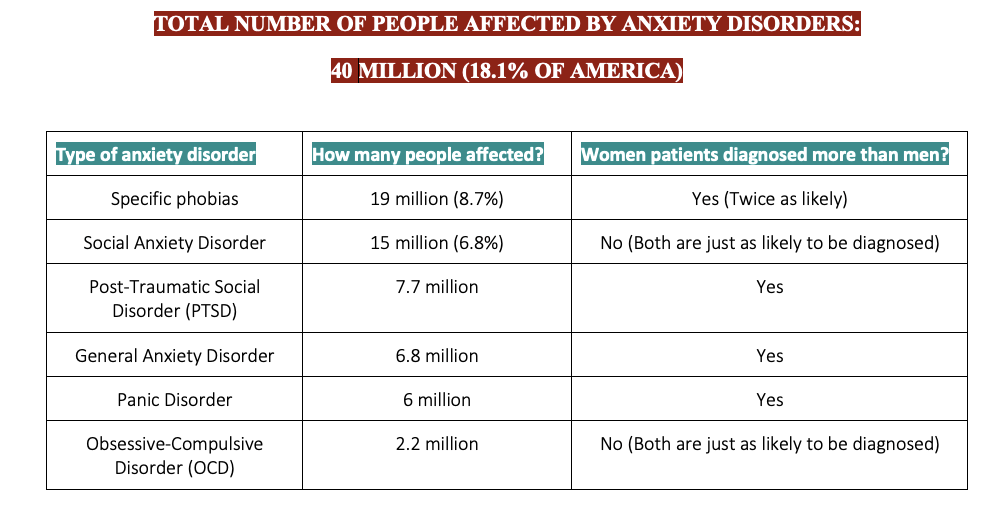
In the US alone, at least 40 millionpeople (18 years and older) are affected by anxiety disorders of some kind every year, making it the most common mental disorder there is. Women are often diagnosed with anxiety disorders more often than men.
Anxiety disorders are easily treatable, and yet only 37% of these 40 million people are receiving treatment. This causes 25.1% of American youth from the ages of 13 to 18 to be affected. Research shows that untreated youths are prone to doing poorly in school, miss out on important social experiences, and abuse substances.
Locally in Singapore, although we are a small city-state, we definitely aren’t immune from the effects of anxiety. Around 10% of people have anxiety and depressive disorders here. Specifically, 1.6% of people (or around 90 219 people) have Generalised Anxiety Disorder, while 3.6% of people have OCD.
Globally, 1 in 13 people (around 592 247 185 people) suffers from anxiety disorders. This is a staggering amount that clearly shows how bad the state of anxiety is.
Sadly, though treatment is widely available, almost 75% of people in remain untreated in less developed countries, leading to a shocking 1 million people taking their lives because of anxiety each year!
Looking at all these statistics, it’s very easy to see the plight of those with anxiety. Hopefully, this post makes you more aware of exactly how many people battle with anxiety around the world. In our next post, we’ll be examining a few misconceptions and stigma that people have about anxiety.
OCD is one of the most common disorders in Singapore. Yes, disorders, not anxiety disorders.
According to the Straits Times, ‘The first and only Singapore Mental Health Study released in 2011 found that Singapore was the OCD capital of the world, with higher rates of the illness compared with the United States or Europe.’
Even then, OCD is one of the most misunderstood disorders in the world. So what exactly is OCD?
We’ve mentioned in this post some symptoms of OCD and anxiety disorders in general, but here we’ll be going into more depth.
OCD is short for obsessive-compulsive disorder. Obsessive-Compulsive Disorder essentially means that the people with it often repeat the same actions over and over again (these actions are often known as “routines”). They do it involuntarily (“compulsions”), and can’t stop thinking about doing these routines (“obsessions”)
These compulsions are so severe for some, if not most, sufferers that they suffer physical anxiety if they do not perform these compulsions. However, performing these actions to alleviate the anxiety may bring on more anxiety as the sufferer is aware of their ritualistic behaviour. Thus, those with OCD end up in stuck in vicious cycles that damage them physically the more they perform their actions.
Often, people with OCD take normal behaviours, such as washing your hands or checking if the lights are switched off, and perform so constantly it becomes unhealthy or even dangerous. For people with OCD, they may wash their hands so often their fingers start to bleed. Even then, the desire to perform these compulsions (like washing their hands) can be so powerful that they can also occupy someone’s mind completely, becoming an obsession that can block out all thoughts of what they are doing, seeing or hearing at that time.
Treatment often includes psychotherapy (which may include exposing you gradually to triggers like dirt through exposure therapy), and certain kinds of medications (such as antidepressants. For more information, read about it here.)
Most importantly, it definitely means a lot for people with OCD to receive support and care from their loved ones. If you yourself don’t have OCD but know someone who does, try your very best to be patient with them, and offer to help with some simple tasks like opening the door for them. Encourage them when they make small improvements as this may motivate them to keep going. Here’s an article that may help you find out more ways to help out.
Hopefully you learned more about OCD as an individual anxiety disorder. Click on to find out about some facts and numbers about just how many people around the world and here in Singapore have anxiety disorders!
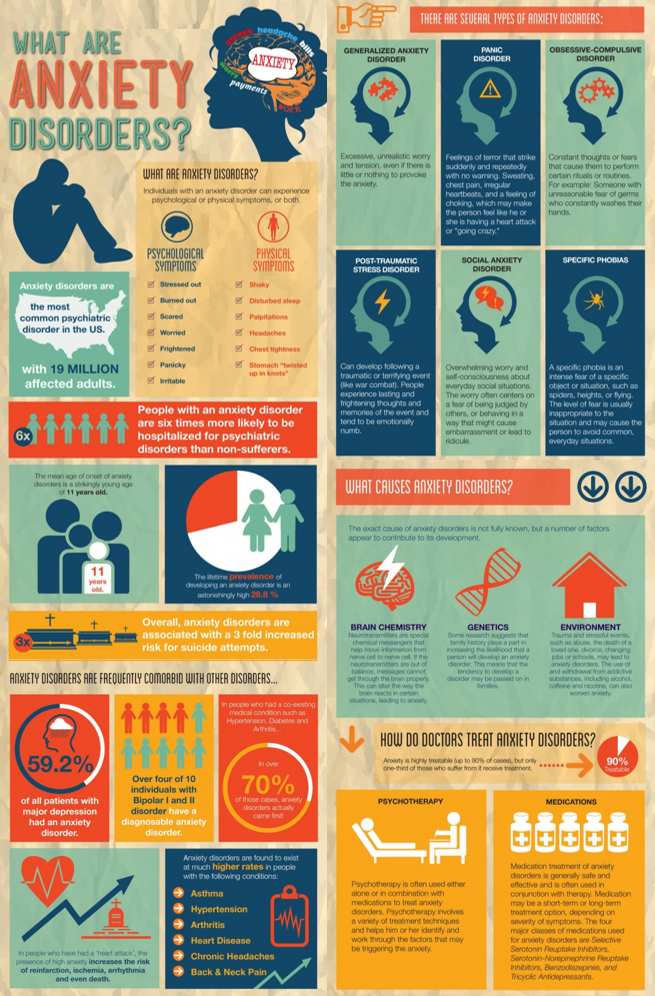
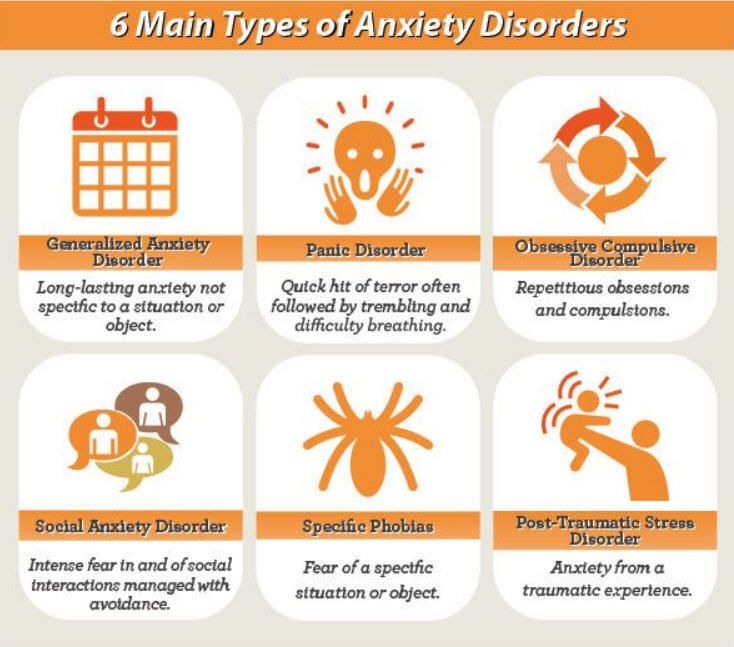
Anxiety, as with many other disorders like ADHD, is divided into many different types. This is because anxiety disorders can manifest in different ways in different people.
Generalised Anxiety Disorder (GAD)
This disorder is probably the one that first jumps to mind when people talk about anxiety disorders. People with GAD usually feel anxious and worried most of the time. This is unlike neurotypical people, whose anxiety and worry may only manifest during stressful situations, like a test or during a presentation.
GAD can interfere with daily life, since people with GAD can’t stop worrying intensely about even the most minor things in their life, such as being five minutes late for an appointment. Their uncontrollable worries and intense anxiety can range from their work life, to their family life, to their health, and financial issues, etc, rather than just being restricted to one issue.
2. Social Phobias
As the name suggests, people with social phobias have an intense, debilitating fear of being criticised, humiliated or embarrassed, even in everyday situations. Social phobic people also aren’t just afraid of relatively big social events like parties or dinners. Social phobic people are afraid of everyday things, such as speaking publicly, eating in public, being assertive at work and even making small talk.
3. Panic disorder
Again, as the name suggests, people with panic disorders are prone to panic attacks. Panic attacks are also one of the main symptoms of anxiety disorder. So what are they? Usually, such panic attacks show themselves in people through physical symptoms, like shortness of breath, dizziness, perspiration and even chest pains.
Some of us may have these attacks from time to time, especially if we’re extremely pressured. However, if you have these attacks more than twice a month, you may be suspected of having a panic disorder.
4. Specific phobias
Remember all those phobias like agoraphobia (fear of crowds) and claustrophobia (fear of enclosed spaces)? It may come as a surprise to you that they fall under anxiety disorders. Taking a look at what physical reactions these phobias involve, though, may soon clear things up.
For instance, someone with claustrophobia entering an enclosed space like a lift or a narrow stairwell may experience an overwhelming sense of panic and dread. These people may go to lengths like changing their work patterns or behaviours or avoided being in situations that will put them in direct contact with their fear. For claustrophobic people, they may take public transport or simply walked in large spaces to avoid their fear.
Phobias have to be consistent for more than 6 months to be diagnosable. Otherwise, it may simply be discomfort from exiting your comfort zone.
5. Post-Traumatic Stress Disorder (PTSD)
Yes, PTSD falls under anxiety disorders too! It should not be that surprising though, considering how it is depicted in popular media, and perhaps displayed to you through family or friends.
Just like people with anxiety, people with PTSD often suffer through anxiety and panic, as well as extreme fear. They are often put in four different kinds of situations:
i. Re-living the traumatic events through vivid dreams and images, often unwanted ones.
ii. Being alert or overtly wound up, which results in sleeping difficulties, irritability and lack of concentration, becoming easily startled and distracted.
iii. Similarly to specific disorders, people with PTSD often avoid reminders of the event which might make them relive their experience, or otherwise remind them of their traumatic experience.
iv. PTSD sufferers feel emotionally numb, losing interest in their day-to-day life, feeling cut off and detached from their family and friends, as well as their favourite activities.
6. Last but not least, Obsessive-Compulsive Disorder (OCD)
OCD, contrary to popular belief, does not only refer to being neat, meticulous and particular about things. As the name suggests, its sufferers go through obsessions and go through motions and habits that eventually become compulsions.
Anxiety disorders are, as proven above, a great interference to the daily lives of the people with them.
Hopefully, you will be now able to understand the distinction between anxiety disorders and be one step closer to understanding people with anxiety. In our next post, we’ll be examining OCD in more detail, so click on to see what it is exactly.
Everyone feels anxious from time to time. But there is a difference between feeling anxious, and having an anxiety disorder. Many times, people often lump anxiety disorders into just feeling anxious, or stereotype its sufferers as people who can’t stop worrying. However, worrying is not the ONLY symptom of anxiety.
According to WebMD, all anxiety disorders share some general symptoms:
Panic, fear, and uneasiness
Sleep problems
Not being able to stay calm and still
Cold, sweaty, numb or tingling hands or feet
Shortness of breath
Heart palpitations
Dry mouth
Nausea
Tense muscles
Dizziness
As with other disorders, doctors can only diagnose you with anxiety if they are sure that no other disorders are causing your symptoms. Hopefully this clears up some misconceptions about what symptoms people with anxiety have, and perhaps reassure you that maybe you don’t have anxiety disorder after all.
On our next post, we’ll be examining the different types of ADHD. Click on to find out more!






 Breaking Through The Stigma on Mental Illness