All posts by 3prfrontdeskfighters

Debunking stigmas and misconceptions (2)

6. You shouldn’t be taking drugs (medicine) if you have ADHD. It will make your condition much worse! You might get addicted!

False, false and false! For people with ADHD, getting the medication they need is actually one of the best things we can do for them! Medication won’t necessarily cure ADHD, but it can help these people manage their symptoms and prevent their symptoms from messing with their daily lives. Studies have also shown that people with ADHD, who don’t receive proper medical treatment and drugs (medicine) are the ones who get addicted to drugs (heroin, cocaine etc).

7. ADHD is over-diagnosed.

Definitely not! Like we said before, ADHD is a very real condition and people who have it definitely do not get diagnosed falsely. Criteria for diagnosis is also very strict. Besides having the six or more symptoms of both inattention and/or hyperactivity up to the age of 16 to 17, four other criteria must be met and combined together, all to prove that a child has ADHD.

8. But I’m a girl! Only boys get ADHD.

Unfortunately, false. It is true that boys are the ones predominantly getting ADHD. After all, they are more than three times more likely to be diagnosed with ADHD (13.2%) However, 5.6% of girls are still diagnosed with ADHD.

9. ADHD isn’t a big deal.

This statement is false, and with far-reaching consequences. People with ADHD may not show it that often, but their lives are severely affected by their condition. Teenagers with ADHD will be in car crashes or other similar traffic accidents four times more likely than their neurotypical peers and seven times more likely to be in a second car crash. Their adult counterparts will be 50% more likely to be in serious car crashes than neurotypical ones. Even if they manage to stay safe long enough for school, 35% of teenagers with ADHD eventually drop out of school. 45% of them have been suspended, and 30% of them have failed and needed to retake one year of school. Most terrifyingly, having ADHD makes you three times more likely to be dead by the age of 45. So, yes. It’s not a big deal, it’s a huge deal.

10. People with ADHD are a danger to society, and they need to be isolated from the world.

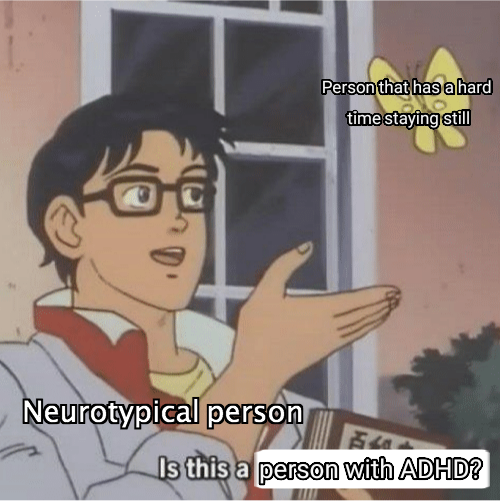
This last statement is absolutely, completely, wrong. People with ADHD, just like people with other mental disorders, are just like you and me. They just have a (much) harder time trying to get through their daily lives. They may get distracted much more easily, and have a hard time trying to stay still. But with the right treatment and guidance, as well as tons of support, people with ADHD can actually succeed and do a lot of good for society! So they definitely should not be locked up, but be loved and supported by the community.

Debunking stigmas and misconceptions (1)

To recap and recall what misconceptions we first discussed, (click here)

1: “ADHD isn’t real!” or “Everyone is a bit ADHD sometimes!”

False! While the symptoms of ADHD can be hard to spot because neurotypical people may also do these things, ADHD is a mental disorder that has been researched and proven to be very real!(In fact, it’s one of the most researched mental disorders) (More on that here)

2: If you can sit still, you definitely don’t have ADHD.

False! While being hyperactive is a symptom of ADHD, ADHD comes in different types; Inattentive, Hyperactive/ Impulsive and a combination of both! Not being physically hyperactive does not always mean a person is ADHD-free. (More on that here)

3: “But you’re smart! You can’t have ADHD!”

False! Anyone can have ADHD and having ADHD doesn’t mean that a person can’t be smart or successful! They just need to work harder and sometimes outside help is appreciated!

4: ADHD is an excuse or result of poor parenting.

We’ve already established that yes. ADHD is real so it’s definitely not an excuse! And while poor parenting does not cause ADHD, It can make symptoms worse. For example, many people with ADHD have trouble regulating their emotions (this is called ‘Emotional Dysfunction’) and react negatively to criticism. Having overly critical parents may cause symptoms to worsen. Encouragement and patience, on the other hand, can do wonders!

5: “You can’t have ADHD! You can focus on ___________!”

Nope! People with ADHD can do something called ‘Hyperfocusing’! And they tend to do so more easily when doing something they find stimulating and enjoyable! (More on that here)

Click on to see us debunk the next 5 most common stigmas and misconceptions about ADHD!

Source 1 & 2


Now onto 10 common stigmas

So! What are some stigmas about ADHD in Singapore?

1: “ADHD isn’t real!” or “Everyone is a bit ADHD sometimes!”

2: If you can sit still, you definitely don’t have ADHD.

3: “But you’re smart! You can’t have ADHD!”

4: ADHD is an excuse or result of poor parenting

5: “You can’t have ADHD! You can focus on ___________!”

6. You shouldn’t be taking drugs (medicine) if you have ADHD. It will make your condition much worse!

7. ADHD is over-diagnosed.

8. But I’m a girl! Only boys are unfortunate enough to get ADHD.

9. ADHD isn’t even that much of a big deal.

10. People with ADHD are a danger to society, and they need to be isolated from the world.

In our next post, we’ll be moving onto debunking these myths. Find out the truth behind the various aspects of ADHD!

Sources:

1) saseye.com/2015/12/14/singapore-overcoming-stigmas-of-learning-disorders/(opens in a new tab)

2) https://psychcentral.com/blog/9-myths-misconceptions-and-stereotypes-about-adhd

3) youtube.com/watch?v=V5tLi1bYilA(opens in a new tab)

4) https://www.medicaldaily.com/11-biggest-myths-and-misconceptions-about-attention-deficit-hyperactivity-disorder-356008


Hyperfocusing

What is hyperfocusing?

Well, ever been so engrossed in something that you become unaware of your surroundings? Yeah it’s something like that but dialled up to 12.

“But how?” You may ask, “I thought that having ADHD makes it hard to focus?”

Well yes! And no.

You see, the thing about people with ADHD is that they don’t actually have a deficit(lack) of attention so much as have trouble regulating their attention.

Think of it as a dial. Most neurotypical people have dials that adjust their attention accordingly depending on what they’re doing.(e.g. 8 for something important like a meeting or a test. 4 for leisure activities etc)

For people with ADHD on the other hand, the dial is on random. It can be anywhere from 3 to 12. When the dial hits 12, that’s hyperfocusing. They become engrossed in what they’re doing. So much so that they may have trouble getting out of that activity!

Hope that helps to clear it up!

(Source)

Some Statistics About ADHD

A large misconception about ADHD is that: it isn’t real. It’s just an excuse for someone who can’t sit still, or who can’t focus. There’s nothing wrong with them.

Well, we’re here to disprove that. And the best way to start is just to show you some simple numbers about people with ADHD.

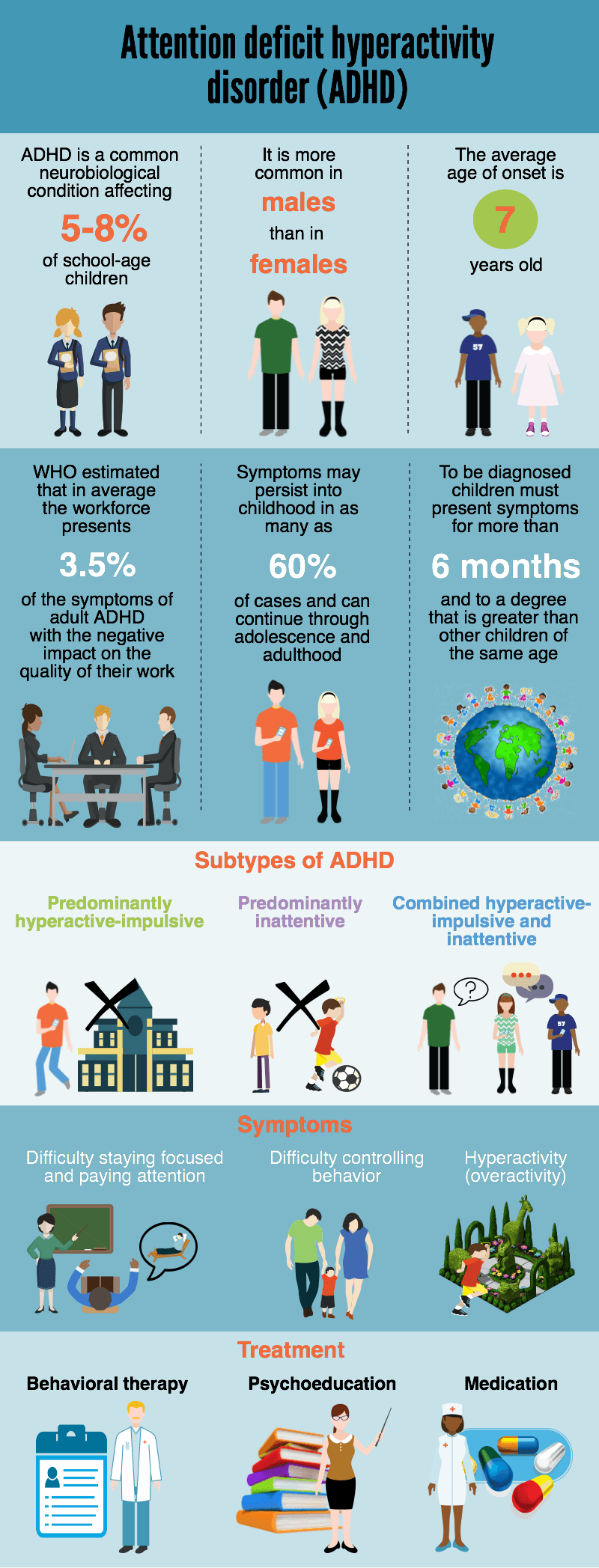
Though it’s a tiny country, some 5% of the child population in Singapore have been diagnosed with ADHD . That number may seem small, but it’s around 270,000 children who have ADHD.

Around the world, that number increases to 6.1 million children who have had ADHD, as of 2016. Still not convinced? Let’s break that data down a little more.

388,000 children from the ages of 2-5 years were diagnosed with ADHD. That number increases to 2.4 million, to the ages of 6-11 years, and to a staggering 3.3 million children from 12-17.

ADHD is also not just a children’s disorder. In many cases, children carry this disorder on to their adult lives. In fact, 4.4% of adults in the US have this disorder, and that’s only the people who seek a diagnosis.

So how many people even have ADHD in Singapore anyways?

Turns out about 17% of children have ADHD and though no studies on how many adults have ADHD in Singapore, but research overseas shows that about half of children with ADHD continue to meet criteria for ADHD as they age.

What about adults?

The estimated crude prevalence rate of current ADHD in Singapore was 5.8%. Adult ADHD was significantly associated with lower age, low educational level, unemployment, marital status (never married and divorced), and rural residency. The worldwide prevalence of people with ADHD was at between 5.29% and 7.1% in children and adolescents and at 3.4% (range 1.2–7.3%) in adults.

But its not the number of people with ADHD that is the issue. If it’s treated properly from a young age, symptoms of ADHD can be managed. Treatment for ADHD in clinics is being improved and criteria for proper treatment is already in place. ADHD only becomes an issue when it isn’t treated and the root cause of that is if children don’t tell anyone about their disorder or if the people they tell, shun them and and encourage these children not to seek treatment.

It would be great if everyone was brave enough to tell someone that they have a stigmatized mental disorder but sadly that isn’t the case. From a study done in 2008, turns out according to parent reports, there were higher rates of children internalising problems (12.2 percent) compared to externalising problems (4.9 percent).

Only about a third of children recover completely. Another third learn to cope with ADHD while the rest get worse if the condition is not identified.
Doctors estimate that 3 to 5 per cent of children here have ADHD. This means that at least 1,500 children in every cohort have the condition, with two-thirds remaining undiagnosed.

We hope that now you’re more clear about people with ADHD. Click on to the next post to find out about more misconceptions people have about ADHD!


Types of ADHD

Hey guys! Remember how we mentioned in this post that there are multiple types of ADHD? Well, I’m going to get more in depth about it here!

ADHD comes in 3 different types; Hyperactive/ Impulsive, Inattentive and a combination of both!

Hyperactive/ Impulsive

This is the most commonly recognisable type of ADHD as it is also the most visible. People with this kind of ADHD tend to be hyperactive physically. Having this type of ADHD is like having a strong motor but weak breaks! People with Hyperactive/ Impulsive ADHD tend to do things before thinking them through and have high energy levels but exhibit adequate control of their attention. This is also the type of ADHD that is most commonly portrayed in media. This type is more common in boys.

Inattentive

This type of ADHD is less common and people who do have this type of ADHD tend to be dismissed as it is less visible. People with Inattentive ADHD are still hyperactive, but instead of physically, it’s internally. It’s very hard for people with this type of ADHD to stay focused. Having Inattentive ADHD is like having a bouncy ball in your head! Your thoughts bounce from topic to topic and you have a harder time retaining information than neurotypical people. The constant jumping from topic to topic tends to make people with Inattentive ADHD more chatty. Moreover, these people often end up having to get their peers to repeat what they said directly after said peers have said it and often blurt out what they want say, often interrupting conversations while doing so, in case they forget. This type is more common in girls, which is also why less girls are diagnosed with ADHD even though anyone can have it.

Combined

This is a combination of the 2 types of ADHD mentioned above. This is the most common form of ADHD.

Remember that there are different types of ADHD and different people experience ADHD differently so be respectful!

(Source 1 & 2)

What are the Symptoms?

What exactly are the symptoms of Attention Deficit Hyperactivity Disorder (ADHD)? Moving too much? Not being able to pay attention?

Yes and more! Here are some common symptoms of ADHD!

First of all, we should mention that symptoms do differ in children and adults! As a result, we’ll be separating them.

Symptoms in adults

Inattention

  • Disorganization
  • Forgetfulness
  • Poor time management
  • Misses part of conversation

Hyperactivity

  • Inner restlessness
  • Inability to relax
  • Feeling down when inactive and happy when stimulated Impulsivity
  • Interrupting, impatient
  • Recklessness, impulsive decision making
  • Switching tasks rapidly

Symptoms in children

Inattention

  • Fails to give close attention to details or makes careless mistakes in schoolwork, work or other activities
  • Has difficulty sustaining attention in tasks or play activities
  • Does not seem to listen when spoken to directly
  • Does not follow through on instructions and fails to finish schoolwork, chores or duties in the workplace (not due to oppositional behavior or failure to understand instructions)
  • Has difficulty organizing tasks and activities
  • Avoids, dislikes or is reluctant to engage in tasks that require sustained mental effort (such as schoolwork or homework)
  • Loses things necessary for tasks or activities (e.g., toys, school assignments, pencils, books or tools)
  • Easily distracted by extraneous stimuli
  • Forgetful in daily activities

Hyperactivity

  • Fidgets with hands or feet or squirms in seat
  • Leaves seat in classroom or in other situations in which remaining seated is expected
  • Runs about or climbs excessively in situations in which it is inappropriate (in adolescents or adults, may be limited to subjective feelings of restlessness)
  • Has difficulty playing or engaging in leisure activities quietly
  • Is often “on the go” or often acts as if “driven by a motor”
  • Talks excessively

Impulsivity

  • Blurts out answers before questions have been completed
  • Difficulty awaiting turn
  • Interrupts or intrudes on others (e.g., butts into conversations or games)

(Source)

Here are also some good videos to look at!

It’s also very important to note that there are different kinds of ADHD and different people may have different symptoms!