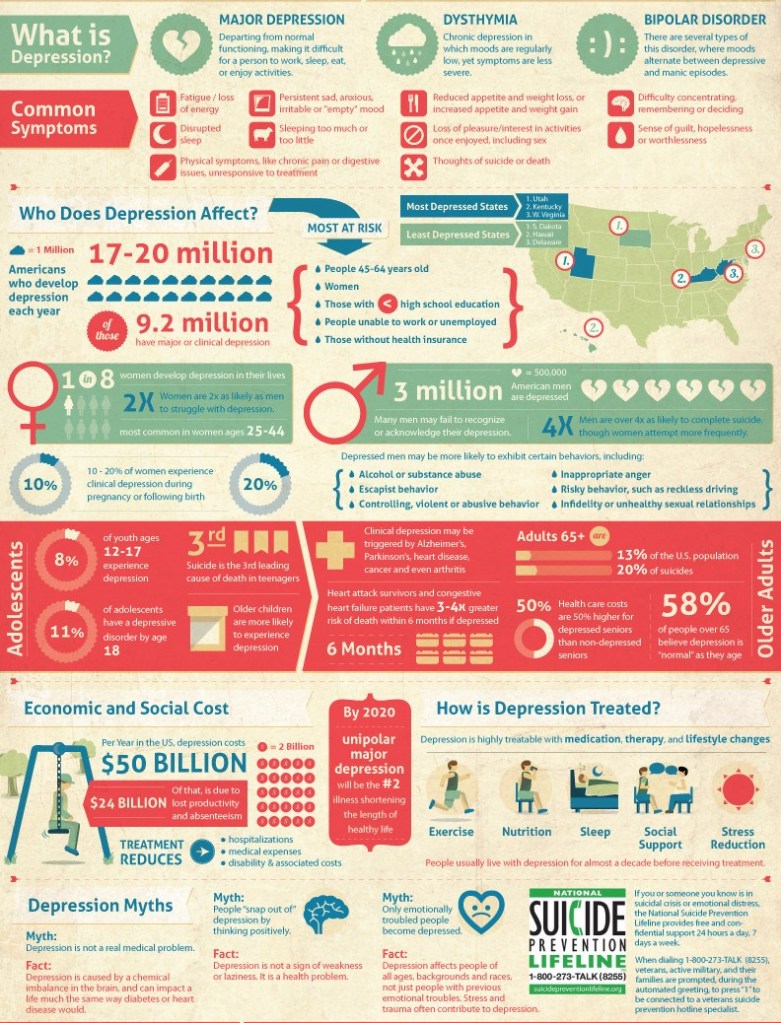
Here’s an overview at what we’ve talked about in the past few blog posts about depression
Thank you for being so patient with us as we talk to you about anxiety, ADHD, and most recently, depression.
We sincerely hope that you’ve all learned something about each of these disorders, whether you have them yourself, know someone who has them, or are simply curious about them.
Remember that people with mental illnesses sometimes aren’t enough to fend off misconceptions and stigmas, so do your best to have an open mind and show your support and care for them.
For those with mental illnesses, remember that you’re not alone, and that it’s not just in your head.
We’d love for this statement to be true! Unfortunately, it isn’t. Mental illnesses like depression can’t just be cured. Additionally, most of the time depressed people need more than medications to help manage their symptoms.
g. “Medication won’t help at all.”
Medication can’t cure depression completely. That definitely doesn’t mean it’s completely useless. Often enough, people with depression need more than medication to help them get better, but medication is a vital part of their recovery. Other treatment methods like getting therapy and even using electroconvulsive therapy, as well as lifestyle changes like getting more sleep and exercising, help people with depression. Combining medication with these treatment methods will make it easier for people with depression to get better.
h. “Talking about it will make it worse, so I should just avoid it.”
Nope! We may be used to treating depression with care and caution, and tiptoeing around the subject. However, by seeing past our stigma and misconceptions about depression and talking about this topic with depressed people around us, we can help initiate conversations about depression. Talking about depression can help people with depression release their self-destructive thoughts and feelings. This can help prevent these thoughts and feelings from becoming too negative. Through talking, we can save people with depression from suicide, or harming other people to let these feelings out.
After all, sometimes people just need someone to talk to about their problems, and we shouldn’t deny them that right.
i. “People with depression can just snap out of it.”
Possibly one of the most common stigmas around depression in Singapore is that treatment is very easy. Simply snap yourself out of it, and you’ll be fine once more!
j. “The best thing I can do for someone with depression is to try cheering them up.”
Often enough, cheering depressed people up can’t really do much. At the most, we can provide with them momentary relief from depression. Medication and therapy are far better (in our opinion) ways of helping someone, and we can help by taking the first steps toward securing these for our loved ones with depression. Often enough, telling them that you support them or just reminding them that you have their backs, especially on days when they struggle to get out of bed in the morning, is one of the best ways we can help.
One last time, let’s debunk misconceptions and stigmas around depression that some people in Singapore might have, starting with the first 5 we mentioned in the previous post:
a. “It’s just something emo(tional) and angsty teenagers made up/something that sad people invented to get attention.”
Not even close. Depression is a very real disorder that doesn’t just strike “angsty” teenagers. In fact, as seen in our statistics post, it strikes many, many people across the world, regardless of gender or age, and is definitely not an invention.
b. “If I feel sad for some days, I must have depression.”
Well, it’s complicated. Although sadness is prevalent in depression, depression is not just feeling sad. If you’re sad over getting bad tests results or if you’re upset over your favourite character’s death, you aren’t immediately diagnosed as depressed. However, if your sadness is persistent for most days for at least 6 months, or 2 years or more, you may just be diagnosed with it.
c. “Depression is a sign of weakness.”
WRONG! Depression affects all kinds of people, like we said. It doesn’t affect people because they aren’t strong enough to avoid getting upset and sad over everything, as some might think. In fact, most people with depression and mental illness in general are probably stronger than most neurotypical (average) people since they have to hide their mental illness from almost everyone they may know.
d. “Men don’t get depression. Only women get it because they’re weaker than men.”
Wrong again! Like we said above, depression affects all kinds of people. And in this post, we showed you that 57,000 men in Singapore were affected by depression in 2016. That may not be as much as the 102,000 women beset by it, but it is still a huge number. A huge reason why people may believe this statement is because stereotypes surrounding men prevent them from showing their emotions, so we don’t know if they’re struggling with depression and/or other mental illnesses. But that does not allow us to dismiss it.
e. “It’s always brought on by traumatic life events.”
Not really. Traumatic life events can bring on a depressive episode, but it won’t really bring on depression in a person itself. People can feel depressed about the loss of a loved one, or their job, but this is not the same as depression. As mentioned above in point b, it takes quite a long time for doctors to accurately diagnose depression.
Depression is one of the most common mental illnesses plaguing Singaporeans. In spite of this, there are still many stigmas and misconceptions surrounding it here. Let’s take a look at 10 of them.
“Psh. It’s just something emo(tional) and angsty teenagers made up/something that sad people invented to get attention.”
“If I feel sad for some days, I must have depression.”
“Depression is a sign of weakness.”
“Men don’t get depression. Only women get it because they’re weaker than men.”
“It’s always brought on by traumatic life events.”
“Medication won’t help at all.”
“Medication will cure you completely.”
“Talking about it will make it worse, so I should just avoid it.”
“The best thing I can do for someone with depression is to try cheering them up.”
Contrary to popular belief, your friend who has mood swings does not have bipolar disorder.
What do we mean?
Similar to what is shown above, Bipolar Disorder is characterised by Manic Episodes quickly followed by Depressive Episodes. The latter symptom, which can result in suicide attempts, are often why bipolar disorder is characterised under Depressive Disorders.
So how would someone with bipolar disorder act?
To simplify bipolar disorder, think of it as people having periods of “fast” activity and “slow” activity. During their “fast” activity, people with bipolar show signs of mania:
Have lots of energy
Feel high or wired
Have racing thoughts
Talk fast
Take more risks
Need less sleep than usual to feel rested
Have more distractions than usual
Have intense senses, such as smell and touch
Sometimes because of their decreased amount of sleep, people with bipolar can feel more irritable and/or energetic than normal. People with bipolar disorder can also have slight hallucinations and delusions. In fact, during their manic episodes, they may even have grandiose senses of self-esteem (feeling like they are superhuman or gods), similar to people with narcissistic personality disorder while they are manic.
These manic episodes can transcend the barrier between normal happiness and sadness and plummet straight towards depressive episodes, with all the usual symptoms of depression:
Sometimes, the depression is enough to send people with bipolar over the edge and towards suicidal behaviour. Other times, the actions they committed while they were in one of their manic episodes may leave them with so much self-hatred and shame that suicide may seem to be the only way out.
Just as we said with depression, this is absolutely NOT the case.
The common saying about suicide is that “it is a permanent solution to a temporary problem.” Of course bipolar is something that people may struggle with their entire lives, and so is not temporary to them. However, with right treatment and support, suicide can have other much better alternatives.
With the right treatment, such as therapy, and medication, as well as support and understanding from family members, bipolar people can help to live much better lives than if they simply suffered in silence. If you have bipolar disorder, we understand that takes a lot of courage to speak up about your condition. Once you’ve spoken up, however, half the battle is already won.
Depression is so common that it is referred to many people as the ‘common cold’ of mental illness. However, is this really true?
According to healthline.com, ‘It’s estimated that 16.2 million adults in the United States, or 6.7 percent of American adults, have had at least one major depressive episode in a given year.’ So how does Singapore compare?
Well, not so good either. The Institute of Mental Health (IMH) did a study on the general mental health state of Singapore in 2016. In it, they found that Major Depressive Disorder was one of the most common disorders in Singapore. The other two were Alcohol Abuse and a disorder we talked to you about earlier, Obsessive-Compulsive Disorder. So exactly how many people are beset by depression? Why is it so serious?
In 2016, the IMH found out that 57,000 men and 102,000 women were affected by this disease. This number may not seem much, but Singapore’s population is much, much smaller than most, a measly 5.8 million. In total, the number of people beset by depression is 3% of Singapore’s population, and every year, that number seems to be growing.
And in fact, according to the World Health Organisation, Singapore had the highest rates of depression across Asia in 2015. That’s compared to bigger countries like Thailand or Indonesia, or fellow metropolises like Tokyo in Japan, or Beijing in China.
So, yeah! Depression is a really serious problem in Singapore.
In spite of this, most people in Singapore still aren’t very educated about depression in Singapore. Let’s move on and examine 10 common stigmas and misconceptions people with depression in Singapore face.
You may know that there are types of ADHD and anxiety, but did you know that there are types of depression too?
Indeed, there are at least 6 types of depression.
1. Major Depressive Disorder
Otherwise known as “major depression”, this type of depression usually occurs when you are depressed most of the time for most days of the week. This is the type of depression that most people probably think of first when “depression” is mentioned.
2. Persistent depressive disorder
This type of disorder used to be separated into two disorders: “dysthymia” or low-grade chronic depression, and major chronic depression. How you can tell if you have persistent depressive disorder is if you have had depression for two years or more, as its name suggests.
3. Bipolar disorder
Did you know that bipolar disorder comes under depression disorders? Yep, bipolar disorder is otherwise known as “manic depression”. Unlike your friends who may just have the occasional mood swings, people with bipolar disorders have extreme mood swings.
For people with bipolar disorders, they may experience “manic” episodes one moment. They may feel over-the-moon, and feel capable of anything. In moments of impulse, they may feel compelled to do actions that may seem fun at the time, but have excruciating consequences later on. After this, they may just as quickly spiral into “depressive” episodes the next moment, which may result in them having all the symptoms of major depression.
4. Seasonal Affective Disorder
Literally abbreviated SAD, Seasonal Affective Disorder can be diagnosed if you are more affected than the winter months than normal. This disorder is a type of seasonal disorder that occurs every year at around the same time, starting in fall or winter and ending around the spring or summer time.
5. Psychotic Depression
This kind of depression combines the symptoms of major depression with “psychotic” symptoms, like hallucinations (seeing or hearing things , delusions (false beliefs) and paranoia (an unusually heightened sense of alertness and cautiousness around others).
6. Post-partum depression
Lastly, this kind of depression afflicts new mothers who have gone through childbirth weeks or months ago. Some new mothers may attest to this, and the causes of this kind of depression are a complex mix of chemical, psychological and social.
7. Other kinds of depression
There are many other subtypes of depression like i) atypical depression, ii) premenstrual dysphoric depression, and iii) ‘situational’ depression. However, these are types of depression are less common. If you would like to find out more about these types of depression, or basically find out more about depression as a whole, click here
Now that you’ve learned more about the symptoms of depression, let’s find out more about the people around the world afflicted with depression.
The video in this post mentioned some symptoms of depression, but here we’ll be going into more depth.
So what are the symptoms of depression?
Firstly and obviously, you will feel sad. However, it’s not the kind of sadness that you may feel because of scoring badly on a test, or because of a rainy day, or even more severe kinds of sadness like grief over the loss of a loved one, or a break-up. Depression can cause you to be persistently sad, empty or even anxious.
Next, depression may make you feel hopeless, pessimistic, guilt, helplessness or even worthless. In serious cases, these feelings may lead to you wanting to take your life.
Third, you may lose your appetite or feel less interested in things you used to love doing (like your hobbies)
Fourth, it’s quite common for people with depression to have a decreased level of energy, or feel fatigued or “slowed down”. So if you feel like you constantly can’t get out of bed in the morning, perhaps you might have depression.
Fifth, general sleep problems like insomnia, oversleeping, early-morning awakening, or oversleeping could only indicate depression.
Sixth, restlessness or general irritability as well as difficulty concentrating, remembering or making decisions, could also be explained by depression.
Last, persistent physical symptoms like headaches, digestive disorders and physical pains that can’t be explained by anything else.
A general note is that if you have depression you don’t necessarily have to have ALL these symptoms. However, for a proper diagnosis, as a general rule of thumb, you need to have at least 5 symptoms or more for an extended period of at least either 1 or 3 at least nearly daily for a sustained period of two weeks.
Now that you’ve understood the symptoms of depression, let’s move onto the types of depression! See you at our next post!




 Breaking Through The Stigma on Mental Illness