
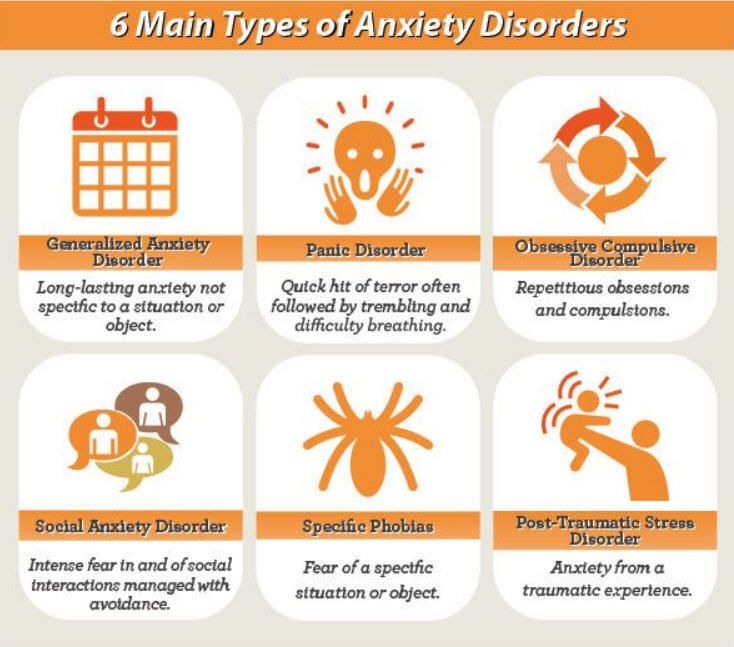
Anxiety, as with many other disorders like ADHD, is divided into many different types. This is because anxiety disorders can manifest in different ways in different people.
- Generalised Anxiety Disorder (GAD)
This disorder is probably the one that first jumps to mind when people talk about anxiety disorders. People with GAD usually feel anxious and worried most of the time. This is unlike neurotypical people, whose anxiety and worry may only manifest during stressful situations, like a test or during a presentation.
GAD can interfere with daily life, since people with GAD can’t stop worrying intensely about even the most minor things in their life, such as being five minutes late for an appointment. Their uncontrollable worries and intense anxiety can range from their work life, to their family life, to their health, and financial issues, etc, rather than just being restricted to one issue.
2. Social Phobias
As the name suggests, people with social phobias have an intense, debilitating fear of being criticised, humiliated or embarrassed, even in everyday situations. Social phobic people also aren’t just afraid of relatively big social events like parties or dinners. Social phobic people are afraid of everyday things, such as speaking publicly, eating in public, being assertive at work and even making small talk.
3. Panic disorder
Again, as the name suggests, people with panic disorders are prone to panic attacks. Panic attacks are also one of the main symptoms of anxiety disorder. So what are they? Usually, such panic attacks show themselves in people through physical symptoms, like shortness of breath, dizziness, perspiration and even chest pains.
Some of us may have these attacks from time to time, especially if we’re extremely pressured. However, if you have these attacks more than twice a month, you may be suspected of having a panic disorder.
4. Specific phobias
Remember all those phobias like agoraphobia (fear of crowds) and claustrophobia (fear of enclosed spaces)? It may come as a surprise to you that they fall under anxiety disorders. Taking a look at what physical reactions these phobias involve, though, may soon clear things up.
For instance, someone with claustrophobia entering an enclosed space like a lift or a narrow stairwell may experience an overwhelming sense of panic and dread. These people may go to lengths like changing their work patterns or behaviours or avoided being in situations that will put them in direct contact with their fear. For claustrophobic people, they may take public transport or simply walked in large spaces to avoid their fear.
Phobias have to be consistent for more than 6 months to be diagnosable. Otherwise, it may simply be discomfort from exiting your comfort zone.
5. Post-Traumatic Stress Disorder (PTSD)
Yes, PTSD falls under anxiety disorders too! It should not be that surprising though, considering how it is depicted in popular media, and perhaps displayed to you through family or friends.
Just like people with anxiety, people with PTSD often suffer through anxiety and panic, as well as extreme fear. They are often put in four different kinds of situations:
i. Re-living the traumatic events through vivid dreams and images, often unwanted ones.
ii. Being alert or overtly wound up, which results in sleeping difficulties, irritability and lack of concentration, becoming easily startled and distracted.
iii. Similarly to specific disorders, people with PTSD often avoid reminders of the event which might make them relive their experience, or otherwise remind them of their traumatic experience.
iv. PTSD sufferers feel emotionally numb, losing interest in their day-to-day life, feeling cut off and detached from their family and friends, as well as their favourite activities.
6. Last but not least, Obsessive-Compulsive Disorder (OCD)
OCD, contrary to popular belief, does not only refer to being neat, meticulous and particular about things. As the name suggests, its sufferers go through obsessions and go through motions and habits that eventually become compulsions.
Anxiety disorders are, as proven above, a great interference to the daily lives of the people with them.
Hopefully, you will be now able to understand the distinction between anxiety disorders and be one step closer to understanding people with anxiety. In our next post, we’ll be examining OCD in more detail, so click on to see what it is exactly.
 Breaking Through The Stigma on Mental Illness